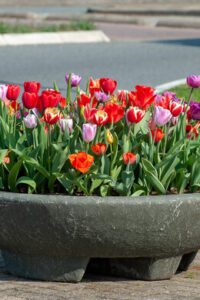
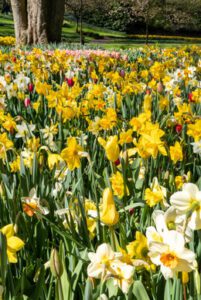
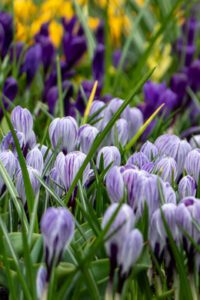
With their high visual experiential value, bulb flowers add color and variety to urban spaces. A planting plan that includes the right mix of types and varieties can create a continuously changing streetscape over a period of up to five months.
Stunning eye-catchers!
It’s not just the blooms of bulb flowers that are gorgeous; the various shapes and shades of green make their foliage attractive and versatile. Any location is suitable and could include roadsides, parks, roundabouts, and even under bushes and trees. Flower boxes or large pots with bulb flowers are real eye-catchers in prominent, highly visible locations.
Ideal mix
In recent years, bulb flower mixes have been popping up in public spaces with increasing frequency. Bulbs like crocus (Crocus), squills (Scilla), and glory-of-the-snow (Chionodoxa) guarantee beautiful blooms early in the year. Daffodils (Narcissus) provide cheerful accents from February to May, depending on the variety. Ornamental onion (Allium) is often added to mixes to extend the flowering period into July. In an ideal mix, dying foliage is obscured by the next species to flower.
Practical
- All these varieties are suitable for naturalizing and can be incorporated into an existing planting of perennials, trees, and shrubs.
- In addition to ready-made mixes, customized mixes can be created to suit a municipality’s location and wishes. Think about specific colors, heights, and contribution to biodiversity.
- A prerequisite for success is for the bulbs to be in the right location and for the planting to be well-maintained.
- Planting can be done mechanically, including under grass. In the latter case, mowing is only needed once or twice a year. This can be done when the foliage has died off above ground. The bulbs will then have stored enough nutrients to bloom profusely the following year.